
Ready to be part of a technological revolution?
Welcome to the innovative Master’s programme «AI‑Augmented Digital Systems Engineering»! We train next‑generation engineers — specialists who can design, develop and manage complex digital systems, enhancing their capabilities with the help of artificial intelligence.
What makes our programme unique?
Our Master’s program is not just about learning — it’s an immersion into the world of cutting‑edge technologies, artificial intelligence (AI), and digital engineering. Artificial intelligence and large language models (LLMs) aren’t just tools here — they’re your trusted partners in innovation.
What you will learn?
During your studies, you will master: designing and developing high‑load and cloud‑based information systems; working with big data (Big Data) and modern storage technologies (Lakehouse); containerising applications and orchestration using Kubernetes; continuous integration and delivery (CI/CD) and infrastructure management via GitOps; creating and testing artificial intelligence systems, including computer vision and natural language processing (NLP); developing and implementing cyber‑technical and robotic systems; applying machine learning and deep learning methods to solve engineering tasks; ensuring security at all development stages (secure coding, testing AI systems); using AI tools for design automation, solution verification and observability analysis; managing projects and teams using agile methodologies (Agile).
What types of projects does the program involve?
Example projects you will work on: developing a cloud platform for the Industrial Internet of Things (IIoT) with predictive analytics elements; creating an intelligent video surveillance system based on computer vision using Edge AI; designing a high‑load natural language processing service using LLMs; automating a CI/CD pipeline for a complex microservice application using GitOps and Kubernetes; developing an integrated robotic complex with AI elements for a logistics centre.
Join the program where technology meets ambition!
Why choose this program?
Step‑by‑step development: from fundamentals to specialization and a real project — you’ll grow alongside the program.
Practice‑oriented: 70–80 % of time is dedicated to real tasks, projects, and tools.
Deep AI integration: you’ll learn to effectively use large language models and intelligent assistants — from automating routine tasks to designing complex systems.
Interdisciplinarity: projects combine knowledge from multiple fields, preparing you for solving complex industry challenges.
Individual approach: the program adapts to your interests and learning pace through varied assignments, portfolio building, and AI‑powered competency analysis.
Modern technologies: you’ll master state‑of‑the‑art tools (Kubernetes, Spark, GitOps, etc.) and be ready for roles in leading companies.
Leadership and project mastery: you’ll develop the skills to lead high‑tech IT teams and manage complex projects in advanced technology environments — from planning and resource allocation to delivery and optimization, ensuring success in fast‑paced, innovation‑driven enterprises.
Career prospects: after graduation, you can pursue roles as an engineer, analyst, architect, or researcher in IT — with skills to thrive in an AI‑driven ecosystem.
Become a specialist who doesn’t follow trends — you’ll set them. Your future in digital engineering and artificial intelligence starts here.
PLACES & FEES
The program is taught entirely in English. Optional Russian language courses are available.
The program offers 25 places for incoming students.
The annual tuition fee for the program is 500 000 (five hundred thousand) Russian rubles. This covers full access to all course materials, digital resources, and campus facilities.
To be considered for admission to the program, candidates must complete the following steps:
Document submission. Upload all required documents through the university’s electronic application system: org.mephi.ru. Please note that applications open on June 20 and cannot be submitted earlier.
Subject exam. Successfully pass a discipline‑specific examination, which is conducted entirely in English.
To help you prepare, we provide a list of sample questions covering key topics of the exam. Find them below.
LEARNING STAGES
Stage 1. Build Your Foundation. Lay the groundwork for success: master algorithmic thinking, programming, databases, and system architecture. Dive into real tools from day one — Jupyter, Kubernetes sandbox — and start collaborating with AI assistants. Learn to frame tasks, analyze results, and harness automation with confidence.
Outcome: You’ll gain digital engineering thinking and the core skills to work with AI — your launchpad for what’s next.
Stage 2. Gain Real‑World Expertise. Level up with industry‑standard tools: Kubernetes, Spark, Kafka, CI/CD, MLOps. Tackle complex, real‑world challenges and choose your specialization — AI, Big Data, DevOps, IIoT, or information systems architecture. Use AI to generate learning scenarios, automate routine tasks, and refine your dialogue with intelligent systems.
Outcome:You’ll master AI‑powered problem solving and discover your professional path.
Stage 3. Lead Your Own Innovation.
Focus on your passion and deliver a unique project: AI track - build an ML‑Ops pipeline or create a computer vision system; DevOps track - deploy a full GitOps + cloud stack and set up Security as Code; Big Data track - design a streaming pipeline for a real business case; IIoT track - bring a digital twin or robotic system to life. Work side‑by‑side with AI: optimize solutions, generate documentation, and build reusable knowledge libraries.
Outcome: A standout portfolio project, deep expertise in your field, and mastery of AI‑driven engineering.
Stage 4. Make Your Mark: The Capstone Project. Put it all together in a large‑scale interdisciplinary project. Join a team with roles like system architect, ML engineer, or DevOps specialist. Solve high‑impact problems with scientific novelty, using LLMs to optimize processes and simulate system behavior. Apply AI for peer review and prepare your master’s thesis — showcasing your unique contribution.
Outcome: A real‑world project for your portfolio, proven teamwork and AI integration skills, and a Master’s degree that opens doors to top tech careers.
CAREER OPPORTUNITIES FOR GRADUATES
Graduates of the programme will be in demand at leading IT companies, startups and corporations implementing digital technologies. Possible career paths include:
AI‑Augmented Systems Engineer — engineer for developing digital systems using AI assistants;
Cloud Architect — cloud solutions architect;
DevOps/SRE Engineer — specialist in continuous integration, delivery and system operations;
Big Data Engineer — big data processing and analysis engineer;
ML Engineer — machine learning engineer;
IoT Systems Architect — Industrial Internet of Things systems architect;
Robotics Systems Engineer — integrated robotic systems engineer;
Prompt Engineer — prompt engineer, specialist in interacting with large language models;
Security Engineer (Secure Coding) — secure software development engineer;
Systems Analyst / Systems Engineer — systems analyst/engineer, specialist in modelling and designing complex systems;
Project Manager (Digital Products) — project manager for digital product development.
KEY FACULTY
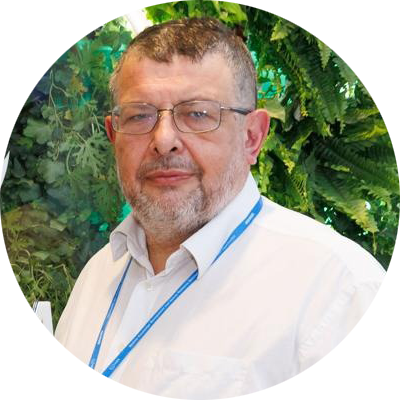
Mikhail Zhabitsky
Head of the Higher Engineering School (HES) at MEPhI, author of the «Digital Engineering» program, as well as the «Internet of Things» and «Digital Design» courses.

Yuri Andrienko
Associate Professor at the HES; Candidate of Physical and Mathematical Sciences (Ph.D. equivalent); author of programming courses (Python, C#, Java) and cybernetic systems design courses

Elizaveta Bobrova
Graduated from HES, Master’s degree in «Information Systems and Technologies», currently a specialist in artificial intelligence and neural networks at a leading Russian IT company.